

How To Repair Horn Wiring On 1977 Chevy Truck
| Chevrolet/GMC Van | |
|---|---|
 | |
| Overview | |
| Manufacturer | Chevrolet/GMC (General Motors) |
| Product | 1964–1996 |
| Assembly | Flint Truck Assembly, Flintstone, Michigan Pontiac Assembly Middle, Pontiac, Michigan |
| Trunk and chassis | |
| Body style | Van |
| Chronology | |
| Predecessor | Chevrolet Greenbrier Sportswagon |
| Successor | Chevrolet Express / GMC Savana |
The Chevrolet Van or Chevy Van (also known as the Chevrolet/GMC G-series vans and GMC Vandura) is a range of vans that was manufactured by General Motors from the 1964 to 1996 model years. Introduced every bit the successor for the rear-engine Corvair Corvan/Greenbrier, the model line likewise replaced the panel van configuration of the Chevrolet Suburban. The model line was sold in passenger van and cargo van configurations equally well as a cutaway van chassis that served as the ground for a diversity of custom applications.
Produced beyond 3 generations (1964–66, 1967–seventy, and 1970–1996), the model line was sold nether a broad variety of model names nether both the Chevrolet and GMC brands. Initially sold as a forward control vehicle (with the engine placed between the seats), the third generation had a conventional layout (placing the engine frontwards of the driver); the second and third-generation serial shared powertrain commonality with the C/K pickup truck model line.
Later the 1996 model year, GM retired the G-Series vans, replacing them with the GMT600-platform Chevrolet Express/GMC Savana (currently in product).
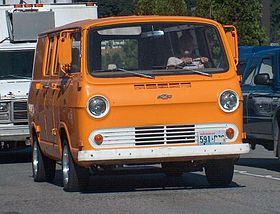
First generation (1964-1966) [edit]
| Kickoff generation | |
|---|---|
 | |
| Overview | |
| Manufacturer | Chevrolet |
| Also called | Chevrolet Sportvan GMC Handi-Van GMC Handi-Passenger vehicle |
| Production | 1964–1966 |
| Assembly | Pontiac, Michigan, U.Due south. |
| Body and chassis | |
| Grade | Meaty van |
| Layout | FMR layout |
| Powertrain | |
| Engine | 153 cu in (ii.5 50) I4 194 cu in (3.ii 50) I6 230 cu in (three.eight 50) I6 |
| Dimensions | |
| Wheelbase | xc in (2,286 mm) |
The first Full general Motors van was the Chevrolet Corvair-based Chevrolet Greenbrier van, or Corvan introduced for 1961, which used a flat-six opposed rear engine with air cooling, inspired by the Volkswagen coach. Production of the Chevrolet Greenbrier concluded during the 1965 model year.
First-generation Chevrolet van refers to the first Thou-10 half-ton production years 1964 through 1966. General Motors saw a market for a compact van based on a modified rider car platform to compete with the already successful Ford Econoline and Dodge A100. The 1964 Chevrolet van had a cab-forward design with the engine placed in a "doghouse" between and behind the front seats. The implementation of situating the commuter on top of the front axle with the engine near the front wheels is called internationally a "cab over" vehicle. Engines and brakes were sourced from the Chevy 2, a more conventional meaty motorcar than Chevrolet Corvair.
This model was also sold by GMC as "Handi-Van". The 1st-generation vans were available in but the short 90-inch wheelbase and were only sold with the standard 153 cu in (2.5 L) 90 hp straight-4 or a Chevrolet Straight-6 engine. A commencement-generation is identified by its single-piece flat windshield drinking glass. The kickoff 1964 Chevrolet van was originally marketed and sold as a panel van for purely commonsensical purposes. Windows were bachelor every bit an option, but were merely cut into the sides from the factory. In 1965, Chevrolet added the "Sportvan", which featured windows actually integrated into the body. GMC marketed its window van equally "Handi-Bus". Air conditioning, power steering, and power brakes were non available in the showtime-generation vans.
1964 [edit]
The new van was of uncomplicated construction and its box shape was designed to maximize the hauling of cargo, tools, and equipment. The base of operations cargo model was the Chevyvan, available with or without windows and side cargo doors. Basic civilities such as a heater and a right-forepart passenger seat were options.
The xc hp (67 kW; 91 PS) 153 cu in (2.5 50) iv-cylinder engine was standard equipment. Optional was the 120 hp (89 kW; 122 PS) 194 cu in (3.2 L) Chevrolet Straight-6 engine.
The Warner 3-speed manual transmission was standard with a column shift. A 2-speed Powerglide automatic transmission was optional.
1965 [edit]
The 1965 model year included minor changes. The grille openings were widened and received i additional slot just above the bumper to increase cooling. Seat belts were added.
The 1965 model year introduced the Chevrolet Sportvan and GMC Handi-Omnibus. The Sportvan was more of a rider-friendly van with windows molded into the van body. A retractable rear courtesy step for the passenger side doors was used on the Sportvan.
The 194 cu in (3.2 L) I6 became standard equipment while the 'Hullo-Torque' 230 cu in (3.8 50) I6 rated at 140 hp (104 kW; 142 PS) was optional.
1966 [edit]
The concluding model twelvemonth of the flat glass front terminate on the Chevrolet vans was 1966. Changes included the addition of dorsum-up lights, the side emblems were moved forward and now mounted on the front end doors, and the antenna location was moved from the right side to the left side.
The base model "Sportvan" now had ii boosted trim packages available: Sportvan Custom and Sportvan Deluxe. These featured bachelor upgrades such as chrome bumpers, two-tone paint, rear passenger seats, interior paneling, padded dash, and chrome horn ring.
Second generation (1967-1970) [edit]
| Second generation | |
|---|---|
 | |
| Overview | |
| Manufacturer | Chevrolet |
| Also called | Chevrolet Sportvan GMC Handi-Van GMC Handi-Charabanc |
| Production | 1967–1970 |
| Assembly | Pontiac, Michigan, U.S. |
| Body and chassis | |
| Class | Van |
| Layout | FMR layout |
| Powertrain | |
| Engine | 230 cu in (iii.8 50) I6 250 cu in (4.1 L) I6 283 cu in (4.vi Fifty) V8 307 cu in (5.0 L) V8 350 cu in (five.7 L) V8 |
| Dimensions | |
| Wheelbase | SWB: ninety in (2,286 mm) LWB: 108 in (2,743 mm) |
In 1967, the Chevrolet van received a major facelift, including moving the headlights downward to a new redesigned grille, larger, rectangular taillights, and a curved windshield. The forrad control cab pattern was retained, but the doghouse was lengthened, widened, and slightly relocated in lodge to fit an optional Chevrolet Pocket-sized-Cake engine. Engine cooling was improved with the add-on of an optional larger cross-flow type radiator and a redesigned front end that included a low-profile tunnel allowing more than fresh air to the radiator. The second-generation vans were available in either the xc or 108 in (2,286 or two,743 mm) wheelbase lengths. Power steering and "conventional" air workout (with dash vents and controls) were never available on the second-generation van.
1967 [edit]
The second-generation Chevrolet van began with the 1967 model, with a new look to the vehicle and offer a longer 108-inch (two,743 mm) wheelbase versions also as an optional V8 engine for the showtime time. The headlights were relocated into a new grille, the rectangular taillights were longer, and the windshield was new. The 1967 model year was the simply early 2d-generation that did non have side marker lights. The forwards control cab blueprint was retained, but the doghouse was widened and lengthened to fit the optional V8 Chevrolet Small-Block engine. Engine cooling was improved with a redesigned doghouse, the addition of a larger optional cross-menstruation type radiator, and a redesigned front floor tunnel to provide more outside air to the radiator.
The original short wheelbase xc inches (2,286 mm) and the new long wheelbase 108-inch (2,743 mm) vans came with 5 on 4&3/4-inch lug bolt pattern. An addition for 1967 was the Yard-20 heavy duty three/4 ton version. The G-20 featured heavier intermission, a 12-commodities rear axle, and increased hauling capability with wheels having a 6-lug bolt pattern. The G-20 model was bachelor only on the 108-inch wheelbase version.
For 1967, the 230 cu in (three.8 50) 140 hp (104 kW; 142 PS) I6 was now standard. Optional were the 250 cu in (4.1 L) 155 hp (116 kW; 157 PS) I6 or a 283 cu in (4.6 L) two-barrel V8 producing 175 hp (130 kW; 177 PS). Brakes were now upgraded to a safer divide organization including a dual reservoir main cylinder.
1968 [edit]
This was the first twelvemonth that Chevrolet vans had side-marker lights, mandated by federal government regulations. The front end lights were located in the middle of the front doors, while the rear marking lights were located near a human foot inward of the rear border just below the vertical middle of the van.
The optional V8 engine was upgraded to a 307 cu in (v.0 50) two-barrel V8 producing 200 hp (149 kW; 203 PS) at 4600 rpm and 300 lbs-ft torque at 2400 RPM).
A column shift 4-speed manual (Borg-Warner T10) was now available equally an option, besides every bit power brakes on the G20 3/four ton vans.
1969 [edit]
For the 1969 model year, the 3-speed TH-350 Turbo-Hydramatic automated transmission was an pick.
"Body-integrated" ac was offered on the Sportvan models. This was not a typical AC setup with nuance vents and controls, but a roof-mounted unit with a single blower duct that had adjustable louvers to straight airflow. The AC unit was independent of the motel heater. It was operated by a single knob on a roof control panel that turned on the AC and allowed the selection of fan speed. With no actual temperature control, the fan speed was the only way to adjust for the desired comfort level.
In the front end, the Chevrolet "bowtie" keepsake was changed from ruby to blue this year.
1970 [edit]
The 1970 model year was the last twelvemonth of the square styling, front drum brakes, and I-beam front axle. The 250 cu in (4.i L) I6 producing 155 hp (116 kW; 157 PS) at 4200 rpm was at present standard. In addition to the 307 cu in (5.0 50) 2-barrel V8, a 350 cu in (5.7 L) 4-barrel (255 HP at 4600 rpm, 355 lbs-ft torque at 3000 rpm) V8 engine may take been available as an choice for the first time in 1970. It is referenced in the possessor'due south manual, just not mentioned in the dealer brochures. The 3-speed automated and transmission 4-speed column shift connected to exist bachelor as transmission options.
Air-conditioning may not have been available for the 1970 model year. It is not listed as an option in a detailed 12-page brochure, and unlike 1969, there is no mention of it in the owner's manual.
3rd generation (1971-1996) [edit]
| Third generation | |
|---|---|
 1986 Chevrolet G20 conversion van | |
| Overview | |
| Manufacturer | Chevrolet |
| Too called | GMC Vandura |
| Production | April 1970 – June 1996 |
| Model years | 1971–1996 |
| Assembly | Lordstown, Ohio, United States Flint, Michigan, United States Scarborough, Ontario, Canada |
| Body and chassis | |
| Class | Total-size van |
| Torso style | 3-door van 3+1 door railroad vehicle 4-door van |
| Layout | Front-engine, rear-wheel drive / four-wheel drive |
| Related | Chevrolet/GMC C/Grand |
| Powertrain | |
| Engine | iv.1L I6 4.3L V6 5.0L V8 5.7L V8 vii.4L V8 vi.2L diesel V8 (1982–93) 6.5L diesel V8 (1994–95) |
| Transmission | 3-speed automatic 4-speed automated 3-speed manual 4-speed transmission |
| Dimensions | |
| Wheelbase | 110 in (2,794 mm) (SWB) 125 in (3,175 mm) (LWB) 146 in (3,708 mm) (EWB) |
| Length | 178.2 in (4,526 mm) (SWB) 202.2 in (5,136 mm) (LWB) 223.2 in (5,669 mm) (EWB) |
| Width | 79.5 in (2,019 mm) |
| Peak | 79.four in (two,017 mm) (SWB) 79.2 in (2,012 mm) (LWB) 79.8 in (2,027 mm) (SWB) 81.nine in (two,080 mm) (LWB) |
In April 1970,[ citation needed ] GM introduced the 3rd-generation G-serial vans as 1971 model-twelvemonth vehicles. In a consummate redesign of the model line, the vans adopted a front-engine configuration (adding a hood to the body[1]). While using a unibody chassis, the tertiary-generation vans derived mechanical components from the 2d- and 3rd-generation C/1000 pickup trucks.
In production for 25 years, the third-generation G-serial vans became one of the longest-produced vehicle platforms designed by General Motors.
Chassis [edit]
In line with the two previous generations, the third-generation Yard-series vans again used unibody construction, integrating the frame rail into the floorpan; the side panels were constructed of a unmarried-slice stamping.[2] The model line was offered three wheelbase lengths: 110 inches, 125 inches, and 146 inches. From 1971 to 1989, the 146-inch wheelbase was used for cutaway chassis; for 1990, a single rear-wheel version was introduced for an extended-length van body.[iii]
The front pause underwent an all-encompassing blueprint alter, deleting its leafage-sprung front beam; in line with C-series pickup trucks, the vans received independent forepart suspension with coil springs and control arms (allowing for much wider spacing of the front wheels[two] [1]). The rear axle break largely remained the same, retaining a leaf-sprung solid rear axle.
The four-cycle drum brakes of the previous generation were abandoned, as the third-generation G-series vans adopted front end disc brakes.[four] [5] The front disc/rear drum configuration remained unchanged throughout the unabridged production of the model line; heavier-duty vehicles received larger brakes.[iii] For 1993, 4-wheel anti-lock braking was added equally a standard characteristic.
Powertrain [edit]
For its 1971 introduction, the Thousand-series model line was offered with three different engines.[i] A 250 cubic-inch inline-vi was offered on all versions with two V8 engines. On the ane⁄2 -ton vehicles, a 307 cubic-inch V8 was optional, with a 350 cubic-inch V8 offered equally an option on 3⁄iv -ton and 1-ton vans. Alongside a 3-speed transmission transmission, the 2-speed Powerglide was offered alongside the 3-speed Turbo-Hydromatic automatic.[1] Later 1972, the Powerglide automatic was dropped.
For 1974, the 307 was discontinued, replaced by a ii-barrel 350 V8 in 1⁄2 -ton vans.[half-dozen] For 1976, the powertrain line was expanded, with the 292 inline-vi becoming the standard engine in 3⁄4 -ton and 1-ton vans; a 305 V8 replaced the 350 two-barrel in i⁄2 -ton vans and a 400 cubic-inch V8 became offered in all versions.[7]
As office of the 1978 model update, the powertrain line underwent further revision, with the 292 vi dropped from One thousand-series vans entirely; GM began the use of metric displacement figures.[8] In line with its use in the C/G trucks, the 6.6 L V8 was dropped from the Thousand-serial for 1981.[9]
For 1982, a half-dozen.2 Fifty V8 became the get-go diesel engine option offered in the ( 3⁄4 -ton and ane-ton) G-series. Shared with the C/K pickup trucks, an overdrive version of the Turbo-Hydramatic was introduced, adding a fourth gear.
In line with the C/K pickup trucks, a 4.iii L V6 replaced the long-running 4.one L inline-6 as the standard engine for 1985. For 1987, the four-barrel carburetor for the V6 was replaced past throttle-body fuel injection (TBI), with the 5.0 Fifty and 5.7 L V8s following suit. Aslope iii-speed and four-speed transmission transmissions, the Chiliad-series vans were offered with 3-speed and four-speed automatic transmissions.[10]
For 1988, a fuel-injected seven.4 L V8 was introduced as an choice,[11] becoming the first large-block V8 offered for the model line. For 1990, manual transmissions were discontinued and the four-speed automatic became standard equipment on most all torso configurations;[3] for 1992, the 4L60E and 4L80E four-speed automatics (renamed from THM700R4 and THM400, respectively) replaced the three-speed entirely.
While the gasoline engine offerings would remain largely unchanged after the 1988 model yr, the 6.2 Fifty diesel was enlarged to half-dozen.5 Fifty for 1994, with merely a naturally-aspirated version offered for the Grand-serial vans.
For 1996, offered merely equally a 1-ton G30 payload series, the "G-Archetype" van continued the apply of non-Vortec engines.[12] The v.7L V8 was now standard (dropping the 5.0L altogether), with the iv.3L V6 as an option merely on standard-wheelbase vans. The 7.4L V8 and half dozen.5L diesel V8 remained options.
| Engine | Engine family | Production | Notes |
|---|---|---|---|
| 250 cu in (4.1 50) inline-6 | Chevrolet direct-6 | 1971-1984 | Initial standard engine on all payload serial |
| 262 cu in (four.3 50) V6 | GM 90° V6 | 1985-1996 | Replaced 4.1L I6 every bit standard engine |
| 292 cu in (4.viii L) inline-6 | Chevrolet straight-vi | 1975-1978 | Replaced 250 I6 as standard engine on 3⁄four -ton, 1-ton vans |
| 305 cu in (5.0 50) V8 | Chevrolet pocket-sized-block V8 | 1976-1995 | Replaced 350 2bbl in 1⁄2 -ton vans |
| 307 cu in (five.0 50) V8 | Chevrolet small-block V8 | 1971-1973 | Optional on 1⁄two -ton vans |
| 350 cu in (5.7 Fifty) V8 | Chevrolet small-scale-block V8 | 1971-1996 | Optional on 3⁄4 -ton, 1-ton vans 2-bbl version replaced 307 in 1⁄2 -ton vans[6] |
| 379 cu in (vi.ii L) V8 diesel | Detroit Diesel fuel V8 | 1982-1993 | Optional on iii⁄4 -ton, 1-ton vans Naturally-aspirated version simply |
| 395 cu in (half-dozen.five L) V8 diesel | 1994-1996 | ||
| 400 cu in (6.6 Fifty) V8 | Chevrolet small-block V8 | 1976-1980 | Optional in all payload series |
| 454 cu in (7.4 L) V8 | Chevrolet large-cake V8 (Marking Iv) | 1988-1996 | Get-go "big-block" V8 engine in G-series van Optional for i-ton vans and cutaway-cab chassis.[xi] |
Body [edit]

1980 Bedford CF (European GM analogue to G-Serial). Designed separately, both model lines are similar in advent
In line with the C/Thou pickup trucks, the G-series vans were sold in i⁄two -ton, three⁄4 -ton, and 1-ton series by both Chevrolet and GMC, with both divisions marketing passenger and cargo vans. Equally role of the shift to a front-engine design layout, the body received a conventional hood, allowing for admission to the engine from outside of the vehicle.[1]
Prior to 1995, the G-series cargo van was sold with simply a commuter's seat (with an optional passenger-side seat).[13] Through its product, passenger vans were sold in multiple seating configurations (dependent on wheelbase), ranging from 5 to 15 passengers.[13] Aslope a windowless rear body, the cargo van was offered in several window configurations.[xiv]
1971-1977 [edit]

1971 Chevrolet G20 (recreational vehicle)

1977 Chevrolet G20 (customized)
Similar in appearance to the European Bedford CF (introduced past GM subsidiary Vauxhall in 1969), the G-serial vans differed from one another in divisional badging. Alongside fender badging, Chevrolet badging was centered inside the grille while GMC lettering was placed on the hood above the grille. In dissimilarity to the "Action-Line" pickup trucks, the vans are fitted with a horizontal-slat grille. Sharing mechanical commonality with the "Action-Line" pickup trucks, the steering column was sourced from the 1969 update of the C/K series; a large engine cover required a separate design for the dashboard.
For 1973, a minor revision changed the color of the Chevrolet "bowtie" emblem from blue to gold.
For 1974, the steering column and dashboard were updated (to more closely friction match the introduction of the "Rounded-Line" C/K pickup trucks).
For 1976, the rear demote seats were redesigned in rider vans, assuasive them to be removed without tools.[xv]
For 1977, a horizontal body line was introduced past the front doors, while fender and rear door badging were updated to match the design of the C/K pickup trucks.
Offered on a longer wheelbase, a cutaway-chassis conversion of the G-series was marketed through Chevrolet and GMC as a cargo truck, as the Hello-Cube Van and MagnaVan, respectively.
1978-1982 [edit]
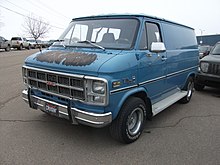
1978-1982 GMC Vandura (110-inch wheelbase)
For 1978, the outside underwent a revision; along with minor changes to the fenders and the introduction of larger bumpers, the grille was redesigned. More closely matching the "Rounded-Line" C/M pickup trucks in its blueprint, the front fascia was restyled to integrate the headlamps and turn signals into ane housing; lower-trim vehicles were offered with circular headlamps with square headlamps fitted to higher-trim models. The dashboard was redesigned with recessed gauge pods and an angled middle console, a pattern that would remain in utilise through 1996.
For 1980, the grille saw a minor revision, adopting larger side-view mirrors for the doors. A locking steering column (with column-mounted ignition switch) was introduced for 1982, with the model line relocating the dimmer switch and wiper controls on the plough signal control stalk. As a i-twelvemonth-simply option, GM offered window drinking glass on the left-side rear door (in identify of both rear doors or neither).
1983-1991 [edit]

1990 GMC Vandura school bus

1985-1991 GMC Rally (in police employ)

Chevrolet van cab and chassis built as an ambulance
For 1983, the Thou-series van underwent a set of small exterior and interior revisions.[ citation needed ] Alongside the C/K pickup trucks, the grille was redesigned, with Chevrolet receiving a horizontally-split grille and GMC receiving a 6-segment grille; rectangular headlamps were standard on all vehicles. The vans received updated fender badging, with each division receiving its own design (distinct from the C/K series).
While retaining the dashboard from 1978, a tilt steering column was introduced (sourcing the steering bicycle from Chevrolet mid-size sedans), moving the manual transmission shifter from the steering column to the floor.
For 1984, the model line introduced a second side-door configuration, with swing-out side doors (in a 1⁄iii / 2⁄iii -carve up) joining the sliding side door equally a no-toll option.[3] For 1985, the exterior underwent an update with larger taillamps and side marker lenses while the horizontal torso line was added to the front doors; the grille pattern was derived from the C/Grand pickup trucks.
For 1990, GM introduced an extended-wheelbase version of the G-serial van (on 1-ton series vans).[3] Sharing its 146-inch wheelbase with the HiCube Van/MagnaVan, the extended-wheelbase van was the commencement version of the model line offered with a fourth rear bench seat, expanding capacity to 15 passengers. While trailing Ford and Contrivance by over a decade, the design was the beginning produced on an extended-wheelbase design. In a small interior revision, the vans adopted the four-spoke steering wheel from the R/V trucks.
1992-1996 [edit]

1992-1996 GMC Vandura 2500/3500 conversion van
After seven years largely unchanged, the G-serial underwent a minor exterior update for the 1992 model twelvemonth, bringing the vans in line with the R/V pickup trucks (the final Rounded-Line trucks). In line with previous versions, two headlights remained standard (on cargo vans and lower-trim passenger vans) with 4 headlights as an choice (on higher-trim rider vans).
Several safety features were phased in during the production of the terminal model update. For 1993, a brake-shift interlock (requiring the restriction pedal to be depressed to shift from park) was introduced. For 1994, a driver's side airbag was added to all vehicles (nether 8,500 lbs GVWR), the new steering bike coincided with the introduction of an updated musical instrument panel.[xiv] In some other change, the 1⁄two -ton passenger van was withdrawn[14] (largely overlapping the Chevrolet Astro/GMC Safari van in size).
For 1993, to bridge the gap betwixt the G-series and the P-series stripped chassis, a heavier-duty version of the G30 cutaway chassis was introduced. Distinguished by its forrad-tilting nose, the variant was effectively a hybrid of the two model lines, mating the P30 chassis with the G30/3500 bodywork; the model line was adult primarily for recreational vehicle (RV) and bus production.
For the 1996 model year, the third-generation 1000-series van was renamed the "Chiliad-Classic" and was pared down to versions with a GVWR above 8,500 pounds; sales were ended in the state of California.[16] Produced concurrently aslope its GMT600 successor, the final G-series van was produced in June 1996.[sixteen]
Trim [edit]
As with previous generations, the model line was again named the Grand-series van (distinct from the intermediate GM G platform). Forth with the previous i⁄2 -ton and 3⁄iv -ton nominal payload series, a 1-ton series was offered for the first time.
Chevrolet [edit]

Offered in ten, 20, and thirty series, the Chevrolet Chevy Van cargo van and Chevrolet Sportvan passenger van were joined past multiple nameplates through the production of the third generation. Revived from the Tri-Five station carriage serial, the 1971-1996 Beauville was the highest-trim Chevrolet passenger van, offering upgraded seats and interior trim.[15] [17] From 1977 to 1981, the Nomad was produced every bit a hybrid cargo/passenger van;[18] [19] a 5-autobus, the Nomad combined the interior trim of the Beauville with a large carpeted cargo area. The Bonaventure was produced during the 1980s as an intermediate trim level between the Sportvan and the Beauville.[20]
As conversion vans were outfitted past 2nd parties, such vehicles were badged with the Chevy Van (and GMC Vandura) cargo van nameplates.
GMC [edit]

1995 GMC Vandura 3500HD, showing tilting hood section
Offered in 1500, 2500, and 3500 serial, the GMC Vandura cargo van (stylized as VANdura from 1977 to 1982) and GMC Rally rider van were the GMC counterparts of the Chevrolet Chevy Van and Sport Van; the GMC Gaucho was a five-rider counterpart of the Chevrolet Nomad van. In line with the GMC Sierra pickup truck, the Rally passenger van was produced across multiple trim levels, with the Rally Custom and Rally STX matching the Bonaventure and Beauville, respectively.
Derived from the cargo van, cutaway van chassis were badged as Vanduras (and Chevy Vans); all examples were 1-ton vehicles (G3500/G30).
Concept vehicles [edit]
In 1966, General Motors developed the concept vehicle Electrovan, based on the GMC Handi-Van. The vehicle used a Union Carbide cryogenic fuel prison cell to ability a 115-horsepower electric motor. It never went into product due to cost bug and safety concerns.[21]
In popular civilisation [edit]

1983 GMC Vandura customized to match the appearance of the A-Team van
Product placement included a customized 1983 GMC Vandura in the 1980s television serial The A-Team that was driven past B. A. Baracus (portrayed by Mr. T).[22]
References [edit]
- ^ a b c d e "1971 Chevrolet Recreation Vehicles brochure". oldcarbrochures.com . Retrieved 2020-08-19 .
- ^ a b "1973 Chevrolet Chevy Van brochure". oldcarbrochures.com . Retrieved 2020-08-xix .
- ^ a b c d eastward "1990 Chevy Van/Vandura" (PDF). gmheritagecenter.com. GM Heritage Center. Retrieved 26 November 2022.
- ^ "1971 Chevrolet Recreation Vehicles brochure". oldcarbrochures.com . Retrieved 2020-08-xix .
- ^ "1970 Chevy Van and Sportvan brochure". oldcarbrochures.com . Retrieved 2020-08-xix .
- ^ a b "1974 Chevrolet Van brochure". oldcarbrochures.com . Retrieved 2020-08-23 .
- ^ "1976 Chevrolet Van brochure". oldcarbrochures.com. Retrieved 2020-08-23 .
- ^ "1979 Trucks and Vans brochure". oldcarbrochures.com . Retrieved 2020-08-23 .
- ^ "1981 Trucks and Vans album". oldcarbrochures.com . Retrieved 2020-08-23 .
- ^ "1987 Chevrolet RPO Listing". oldcarbrochures.com. Retrieved 2020-08-24 .
- ^ a b "1988 GMC Trucks Folder". oldcarbrochures.com. Retrieved 2020-08-24 .
- ^ "Chevy Trucks | Specifications | 1996 Chevrolet G-Van" (PDF). GM Heritage Center | Vehicle Information Kits (1996 Chevrolet One thousand-Van). p. 81. Archived (PDF) from the original on 2022-07-thirty.
- ^ a b "1995 Chevrolet G-van - Model Selection Summary" (PDF). GM Heritage Center - Vehicle Data Kits (1995 Chevrolet G-Van).
- ^ a b c "1994 Chevrolet Van Ordering Data" (PDF). GM Heritage Center - Vehicle Information Kits (1994 Chevrolet G-van).
- ^ a b "1976 Chevrolet Sportvan Brochure". oldcarbrochures.com . Retrieved 2020-08-26 .
- ^ a b "Chevy Trucks Specifications - 1996 Chevrolet G-van" (PDF). GM Heritage Eye - Vehicle Information Kits - 1996 Chevrolet G-van. p. 79.
- ^ "1979 Chevrolet Vans brochure". oldcarbrochures.com . Retrieved 2020-08-26 .
- ^ "1979 Chevrolet Vans brochure". oldcarbrochures.com . Retrieved 2020-08-26 .
- ^ "1981 Trucks and Vans album". oldcarbrochures.com . Retrieved 2020-08-26 .
- ^ "1985 Chevrolet Van/GMC Vandura Model Selector" (PDF). GM Heritage Center - GM Heritage Archive - Vehicle Information Kits.
- ^ "Individual Sector; An Electrovan, Not an Edsel". Nytimes.com. 2002-11-17. Retrieved 2011-08-06 .
- ^ "A-Team'southward 1983 GMC G-Series (Thousand-fifteen) Van - Classic TV Cars". Classic TV Cars. Retrieved 20 December 2022.
- Hall, Douglas Kent (1977). Van People: The Great American Rainbow Boogie. New York: T.Y. Crowell.
- Mellon, Thomas A. Chevrolet, GMC one/2, 3/four, 1 Ton Van Repair & Service Manual 1967–1986. Chilton'south Transmission.
External links [edit]
- The beginning fuel cell vehicle was built from a Chevrolet Van in 1966
- 1977 GMC Trucks Brochure (Old Car Brochures)

Source: https://en.wikipedia.org/wiki/Chevrolet_van
Posted by: horstdinted1954.blogspot.com
0 Response to "How To Repair Horn Wiring On 1977 Chevy Truck"
Post a Comment